
India's Leader in 3D Printing Services
Upload your CAD file for instant quotes across SLA, SLS, FDM, and MJF 3D printing and get overnight delivery. Join 5,500+ engineers who trust us.
⭐ 4.9/5 Rated by 891 Engineers 🔒 ISO 27001 Secure Uploads


Our 3D Printing Services
Experience India's widest and largest 3D printing services, with free online instant quotations.
SLA 3D Printing Services
SLA - Stereolithography
SLA 3D printing offers fast and precise parts with smooth surface finishes and exceptional detail, making it ideal for rapid prototyping and showcase models.
Materials: ABS, Clear PC-Like
Max Print Size: up to 1200mm
Delivery within 24 Hours

SLS 3D PRINTING SERVICES
SLS - Selective Laser Sintering
SLS 3D printing delivers nylon-grade parts, making it ideal for rapid prototyping, end-use functional models and low-batch production.
Materials: Nylon PA12, PA12 + Glass Filled
Max Print Size: up to 450mm
Delivery within 3 days

DLP 3D PRINTING SERVICES
DLP - Digital Light Processing
When design becomes challenging, 3D Systems Figure 4 delivers ultra-thin production grade parts within hours.
Materials: Pro-Black 10, Rubber65A
Max Print Size: up to 200mm
Delivery within hours

FDM 3D PRINTING SERVICE
FDM - Fused Deposition Modeling
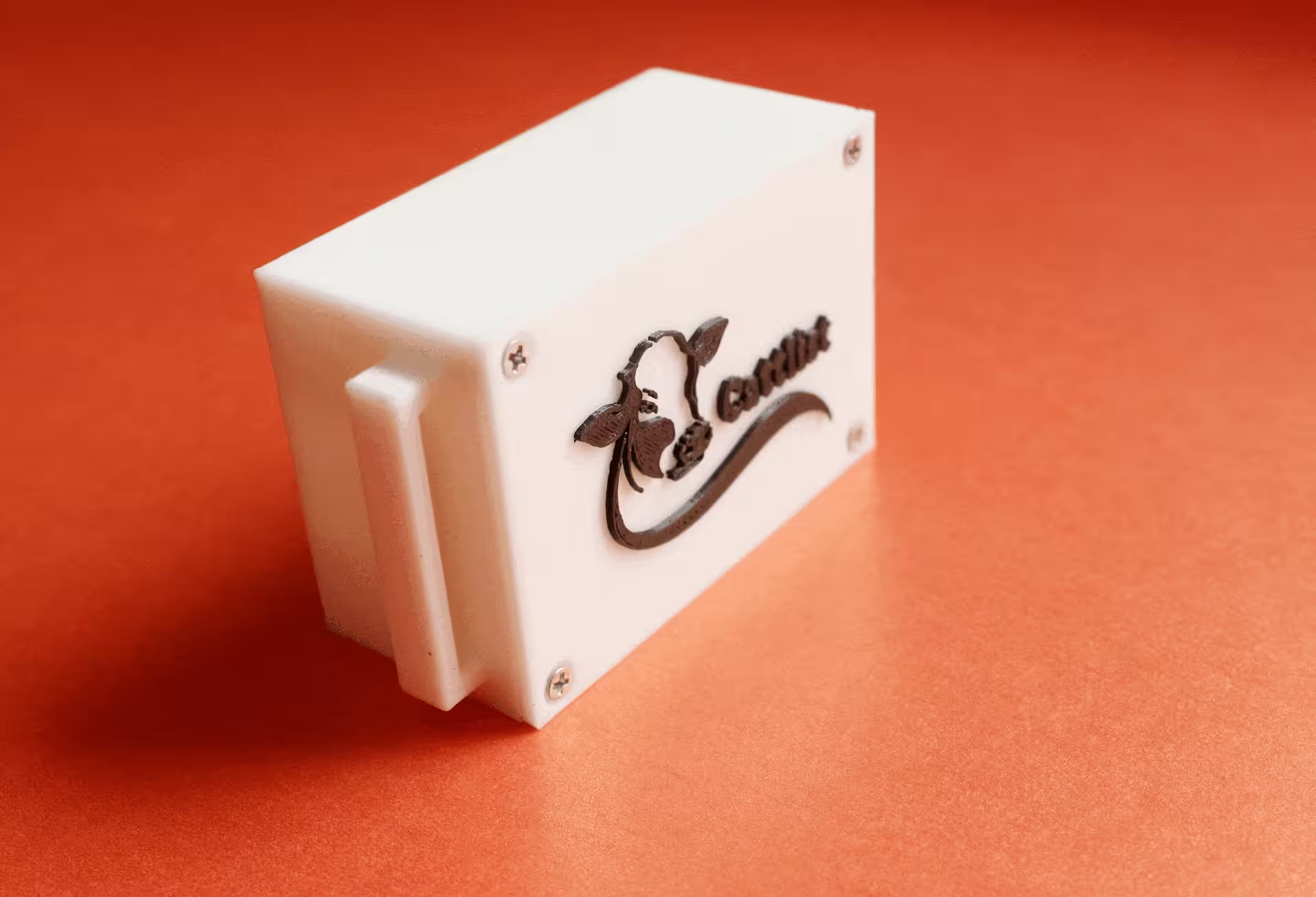
FDM 3D printing offers economical prototyping producing strong, durable parts using a variety of filament materials.
Materias: PLA, ABS, TPU, PETG, PC
Max Print Size: up to 500mm
Same day delivery

HP MJF 3D PRINTING SERVICES
HP MJF - Multi Jet Fusion
MJF delivers nylon PA12 end-use parts, which are bio-compatible and well suited for functional rapid prototyping.
Materials: PA12 Nylon (Greyish Black)
Max Print Size: up to 250mm
Delivery within 3 days

3D Scanning & Product Design
3D Scanning & Modeling
Our expert CAD engineers turn your concepts into precise, production‑ready designs—bringing your ideas to life with accuracy and speed.
Simple Part Modifications
Designing products from concepts
Reverse Engineering Services (3D Scanning)

Painting and Finishing
In-house Post Process
Get exceptional finishes and precise RAL color matching, ensuring your parts look exactly as you imagined.
Automotive grade paint booth facility
Finishes: Matte, Glossy, SoftTouch
Delivery within 48 Hours

Outputs that speaks for itself
These works exemplify our expertise in delivering high-performance, customized 3D printed parts that meet industry standards delivered under tightest of timelines.
SLA-ABS
SLA-Clear
SLS-Nylon
FDM
Production-grade
Low-Batch
MJF
3D Scanning










Industry-Focused 3D Printing Solutions
Customized 3D printing services for automotive, aerospace, defense, healthcare, and more.

EV Battery Management System
EV Automotive

EV Charging Stations
Interior and Exterior Components

EV Cell Holder 3D Printing
2W/4W Automotive

Assembly Jigs & Assembly
Automotive & Robotics

Nylon SLS 3D Printing Services
Aerospace & Defense

Aerospace & Defense
Representation Model

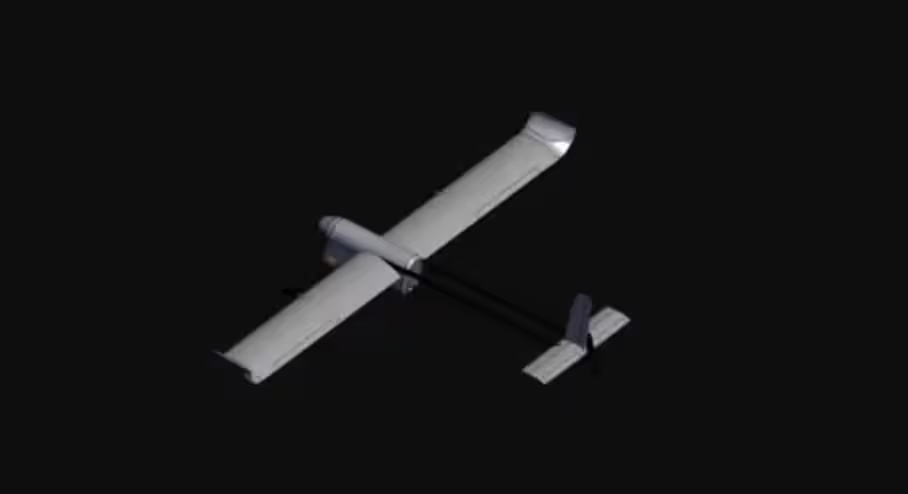
Unmanned UAV 3D Printing
Aerospace & Defense

Canopies, Rubber Pads
Aerospace & Defence

Bio-Compatible Enclosures
Healthcare & Medical

Anatomical models for surgical planning
Healthcare & Medical

Bio Surgical guides
Healthcare & Medical

Industrial Grade Jigs & Fixture
Manufacturing & Tooling

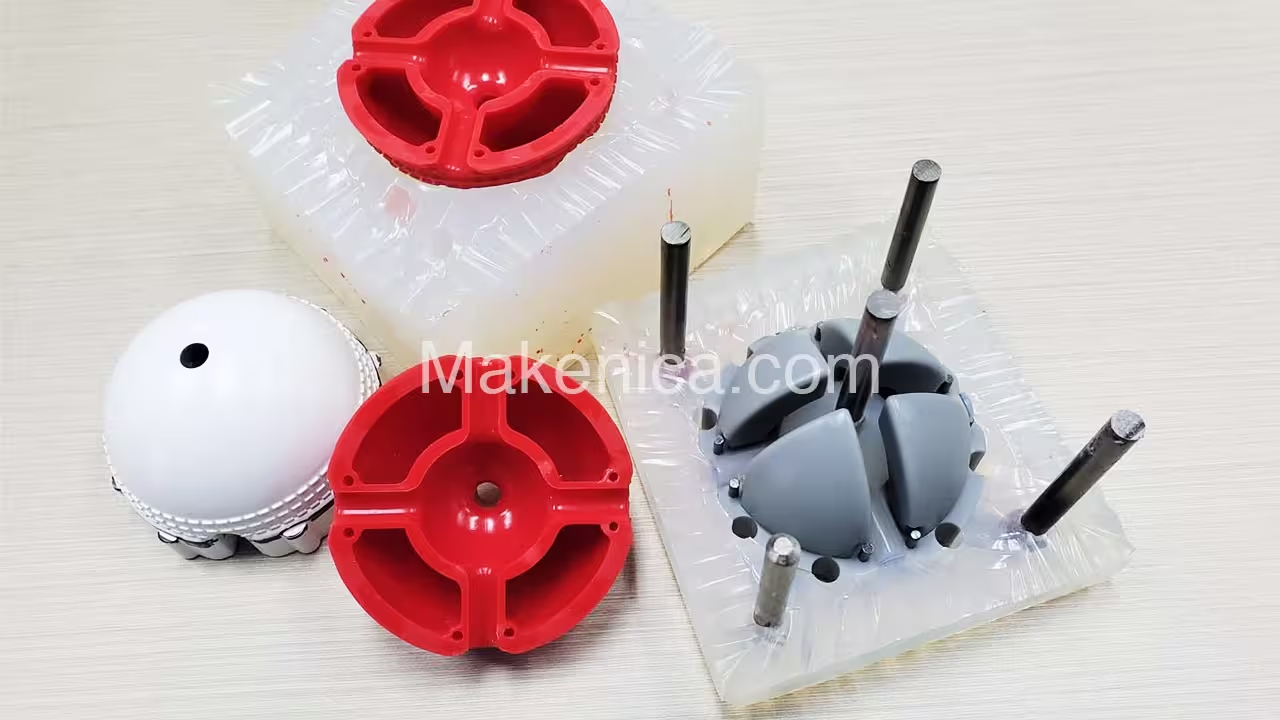
Low Batch Production
Manufacturing & Tooling

Rapid Prototyping
Manufacturing & Tooling

Custom insoles and midsoles
Footwear

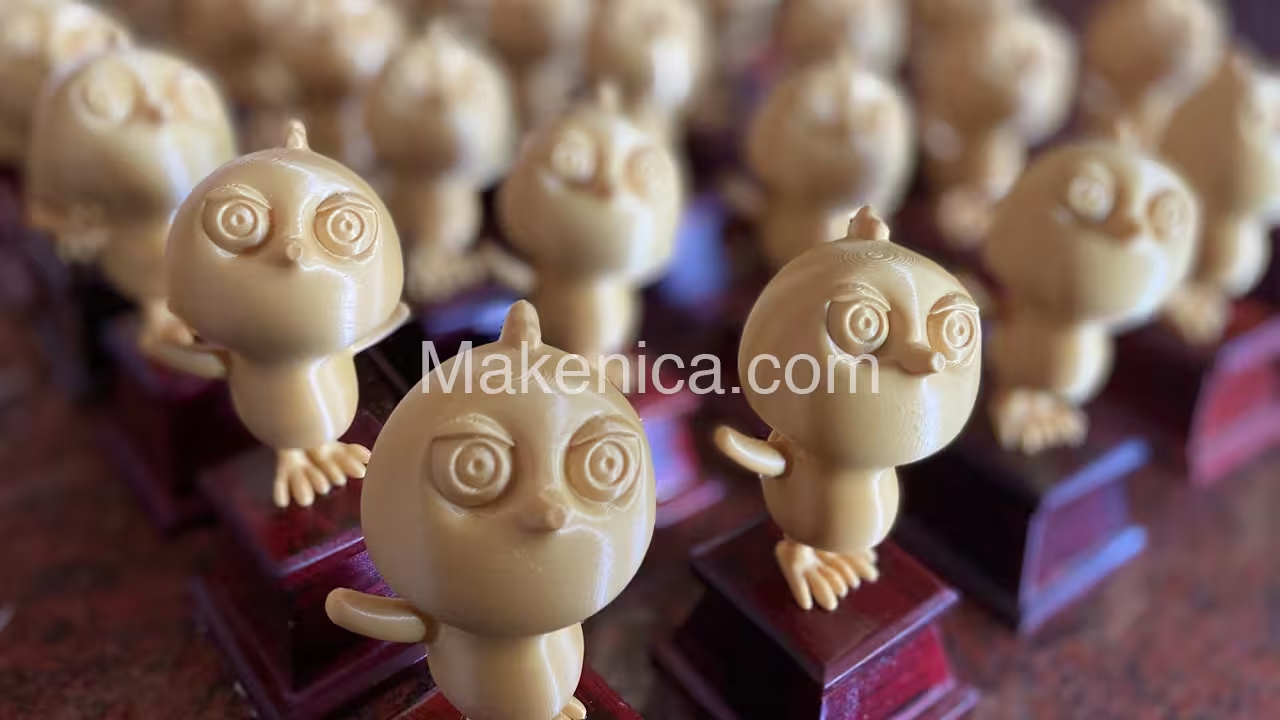
Toys & Action Figures 3D Printing
Consumer Products

Customized Home Decor
Consumer Products

Scale models of buildings
Architecture & Construction

Props, Sets and costumes
Film & Entertainment
EV Battery Management System
EV Automotive
EV Charging Stations
Interior and Exterior Components
EV Cell Holder 3D Printing
2W/4W Automotive
Assembly Jigs & Assembly
Automotive & Robotics
Nylon SLS 3D Printing Services
Aerospace & Defense
Aerospace & Defense
Representation Model
Unmanned UAV 3D Printing
Aerospace & Defense
Canopies, Rubber Pads
Aerospace & Defence
Bio-Compatible Enclosures
Healthcare & Medical
Anatomical models for surgical planning
Healthcare & Medical
Bio Surgical guides
Healthcare & Medical
Industrial Grade Jigs & Fixture
Manufacturing & Tooling
Low Batch Production
Manufacturing & Tooling
Rapid Prototyping
Manufacturing & Tooling
Custom insoles and midsoles
Footwear
Toys & Action Figures 3D Printing
Consumer Products
Customized Home Decor
Consumer Products
Scale models of buildings
Architecture & Construction
Props, Sets and costumes
Film & Entertainment
EV Battery Management System
EV Automotive
EV Charging Stations
Interior and Exterior Components
EV Cell Holder 3D Printing
2W/4W Automotive
Assembly Jigs & Assembly
Automotive & Robotics
Nylon SLS 3D Printing Services
Aerospace & Defense
Aerospace & Defense
Representation Model
Unmanned UAV 3D Printing
Aerospace & Defense
Canopies, Rubber Pads
Aerospace & Defence
Bio-Compatible Enclosures
Healthcare & Medical
Anatomical models for surgical planning
Healthcare & Medical
Bio Surgical guides
Healthcare & Medical
Industrial Grade Jigs & Fixture
Manufacturing & Tooling
Low Batch Production
Manufacturing & Tooling
Rapid Prototyping
Manufacturing & Tooling
Custom insoles and midsoles
Footwear
Toys & Action Figures 3D Printing
Consumer Products
Customized Home Decor
Consumer Products
Scale models of buildings
Architecture & Construction
Props, Sets and costumes
Film & Entertainment
Trusted by Industry Leaders Nationwide
From top brands to future icons, we help turn bold ideas into reality.


Meet Makenica®
3D Printing Since 2016
Founded by passionate makers, Makenica grew from firsthand manufacturing challenges into a mission—empowering the next generation of makers with the tools, support, and transparency we once needed.


How Makenica Works?
Transform your ideas into 3D printed parts—faster than ever. Upload your CAD file for instant quoting, rapid production, and doorstep delivery with end-to-end quality control.

1. Upload your CAD
One Click Login to upload your CAD files (STL, STP, OBJ)
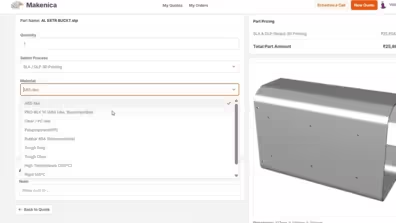
2. Get Instant Quotation
Get real-time instant pricing based on your CAD.

3. Start 3D Printing
Your parts move into production within hours.

4. Quality Control
Quality Control Team verifies accuracy & consistency.

5. Ready for Delivery
Shipped using top courier partners to ensure safe delivery.
Frequent questions & answers
Answers to questions about our 3d printing services and quotation platform.
3D printing, also called additive manufacturing, is the process of building three-dimensional objects from a CAD or digital 3D model by adding material layer by layer under computer control.
Unlike subtractive methods that remove material, additive processes deposit, join, or solidify materials such as plastics, liquids, or powder grains to form parts with complex geometries and internal features that would be difficult to achieve with traditional manufacturing.
A typical workflow starts with designing or sourcing a 3D model, exporting it to a printable format like STL or AMF, and using slicing software to convert it into machine instructions before printing layer by layer.
Common technologies include:
These processes are defined under ISO/ASTM 52900.
Slicing software segments the model into thin layers and generates G‑code or equivalent commands tailored to the selected printer and process parameters.
Key advantages include rapid prototyping, reduced material waste, mass customization, and the ability to produce lightweight, high-complexity parts with minimal tooling.
Industries such as aerospace, medical, automotive, and consumer products use 3D printing to accelerate development, cut costs, and enable on-demand manufacturing at various scales.
Modern printers and materials have improved precision and repeatability, making 3D printing viable for both prototyping and production in many applications.
Design and orientation strongly affect outcomes: thin walls, long unsupported spans, and heat-sensitive geometries may deviate more. We advise hole compensations (e.g., +0.2–0.4 mm), clearance fits of 0.2–0.5 mm per side, and adding fillets/ribs for stability. On request, we provide First Article checks, dimensional reports, or 3D scan-to-CAD deviation maps for critical dimensions to meet your tolerance stack-up and quality plan.
The process begins with a CAD model exported as STL/AMF/3MF, which is imported into a slicer that converts the geometry into layer‑by‑layer toolpaths and creates a G‑code or process‑specific file .
Slicers also configure parameters such as layer height, infill density, supports, rafts/brims, extrusion/temperature controls, and speed, all of which influence accuracy, surface quality, and strength .
Once sliced, the file is transferred to the printer via SD/USB/Wi‑Fi, and the machine builds the part by stacking layers—either extruding melted thermoplastic, curing resin with light, or fusing powder with heat/energy depending on the technology .
Material extrusion (FDM) deposits filament through a heated nozzle, vat photopolymerization (SLA/DLP) cures liquid resin selectively, and powder bed fusion (SLS/SLM/MJF/EBM) sinters or melts powder to form dense layers .
After printing, post‑processing such as support removal, washing/curing, bead blasting, sanding, or heat treatment refines dimensions, surface finish, and mechanical properties .
The combination of proper modeling, correct slicing settings, and appropriate technology/material selection ensures dimensional accuracy, repeatability, and performance for the intended use .
By optimizing orientation, supports, and infill, the workflow balances build time, cost, and part strength for prototypes and production parts alike .
Prepare or obtain a CAD model, check it for errors, and export to STL/AMF/3MF before importing into slicing software such as Cura, PrusaSlicer, or Slic3r for toolpath generation .
In the slicer, set layer height, infill density/pattern, perimeters, and temperatures; add supports for overhangs and choose rafts/brims if bed adhesion or first‑layer reliability is a concern .
Orient the model to minimize supports, improve surface quality on critical faces, and reduce Z‑height to shorten build time without compromising strength or accuracy .
Transfer the sliced file to the printer via SD/USB/Wi‑Fi and start the print, ensuring calibrated bed leveling, correct nozzle/bed temperatures, and adequate ventilation/safety for the chosen material .
After printing, remove supports, wash/UV cure resin parts if applicable, and perform finishing such as bead blasting or sanding to achieve the desired surface and dimensional precision .
Validate fit and function and iterate slicer settings or design features if needed, adjusting infill, wall counts, or orientation to balance strength, weight, and time .
Popular slicers and ecosystems like Cura and Slic3r support extensive parameter control and profiles to streamline repeatable, high‑quality prints for beginners and professionals .
We support NDA by default for sensitive designs. For recurring orders, set preferred materials, color standards, and QC checkpoints, so repeat prints are consistent across batches.
We can integrate threaded inserts, heat-set brass inserts, helicoils, magnets, and bushings, and perform secondary operations like reaming, tapping, and machining to dial in critical fits. Surface finishing (bead blast, dyeing, painting, vapor/chemical smoothing) and sealing are available for appearance and fluid/air tests. Share your load, temperature, environment, and life-cycle targets—our team will propose a testable build with orientation and tolerancing optimized for success, and can iterate quickly based on your test feedback.
Tell us your target finish, color, gloss, and tolerance priorities, and we will propose the most cost-effective post-processing stack for your part and use case.
We work under NDA, support STEP/IGES/native files, and can turn around practical DfAM improvements within 24–48 hours for most parts.
Pricing improves with volume because part nesting, machine utilization, and setup amortization get better over larger batches. We’ll recommend design tweaks that lower unit cost at scale (wall optimization, orientation, combining parts, standard finishes). If your part needs post-machining, painting, or assemblies, we can plan batch fixtures and consistent workflows to keep costs predictable. Whether you’re in Bangalore, Mumbai, Delhi, or shipping PAN-India, we align capacity to your demand and deadlines without forcing a minimum quantity.
Indicative ranges to help you budget:
Cost reduction tips:
Upload your CAD for an instant, itemized quote that compares materials, processes, and finishes so you can pick the best cost-performance option.
It replaces a solid interior with a controlled pattern so you can balance weight, durability, and print speed without compromising the part’s purpose.
Slicing software converts solid volumes into shells with adjustable infill density, expressed from 0% (hollow) to 100% (solid), giving precise control over weight, strength, and print duration.
Lower densities suit display models, while higher densities are used for functional components that must withstand mechanical loads and repeated use.
Different patterns distribute forces differently and affect print time and material use; common options include rectilinear, grid, triangles, cubic, gyroid, and tri‑hex, each offering distinct isotropy, compression resistance, and efficiency characteristics.
Gyroid is popular because it is continuous and mathematically periodic, delivering a strong, uniform structure with excellent strength‑to‑weight efficiency for many functional prints.
Selecting infill is about matching density and pattern to real load paths while also tuning wall/perimeter counts, which often contribute more to overall strength than simply increasing infill alone.
Modern slicers enable per‑model or region‑specific strategies to reinforce critical areas while keeping noncritical zones lightweight and fast to produce.
Optimized infill reduces cost and build time without sacrificing targeted performance, making it a core lever in design for additive manufacturing.
A slicer sets motion paths, extrusion/energy inputs, and temperatures while segmenting geometry into stacks of layers that the printer can execute for FDM, resin, or powder‑based systems .
Beyond basic toolpaths, slicers manage infill density, support structures for overhangs, and first‑layer aids like rafts, skirts, and brims to improve adhesion and reliability .
Support strategies include lattice and tree supports, the latter often easier to remove and more material efficient for complex overhangs and branching features .
Popular slicers such as Cura, PrusaSlicer, and Slic3r offer extensive controls, profiles, and previews to optimize quality, time, and filament/powder usage .
Fine‑tuning layer height, wall counts, speeds, and cooling can dramatically affect surface finish, dimensional accuracy, and mechanical performance of printed parts .
The slicer’s output file is transferred to the printer for execution via SD/USB/Wi‑Fi, where each command is carried out in sequence to fabricate the physical object .
Effective slicing aligns print settings with part geometry and function, ensuring success while minimizing waste and post‑processing burdens .
Powder bed fusion selectively melts or sinters fine metal powders layer by layer using lasers or electron beams to produce dense parts with properties comparable to conventionally made alloys .
Comprehensive reviews highlight that metal AM supports a wide range of materials such as titanium, aluminum, stainless steels, and superalloys, with applications across aerospace, medical, energy, and tooling .
Binder jetting creates “green” parts from metal powder with a binder before sintering, while DED fuses feedstock (powder or wire) with a focused energy source for repairs or large builds .
Industrial practitioners describe metal powder bed fusion as a digitally driven, layerwise process that builds functional parts in alloys like Ti‑6Al‑4V, Co‑Cr, Inconel 625/718, stainless steels, and AlSi10Mg .
Metal 3D printers and ancillary equipment (e.g., powder handling, heat treatment, support removal) entail higher capital and operating costs than polymer systems, but deliver unique design freedom and consolidation benefits .
Use cases include lightweight lattice structures, conformal cooling, patient‑specific implants, and reduced assembly count through part integration .
Selecting the right metal process depends on geometry, size, surface finish needs, and downstream treatments required for final performance and certification .
It accelerates prototyping and iteration, shortening development cycles and improving time‑to‑market while reducing upfront tooling costs for low‑volume runs .
Material is added only where needed, decreasing waste and often lowering environmental impact compared to subtractive methods that remove excess stock .
Mass customization allows tailored products and on‑demand production without prohibitive setup times, supporting agile supply and localized manufacturing .
Businesses benefit through faster design validation, lower inventory risk, and the ability to consolidate assemblies into fewer printed parts for cost and reliability gains .
These advantages apply across industries—medical, aerospace, automotive, consumer products—where customization, speed, and complexity deliver measurable value .
Typical workflows include preparing the object, scanning with laser/structured‑light/photogrammetry systems, and post‑processing to register, clean, and mesh point clouds into usable CAD or polygon models .
Preparation may involve applying non‑reflective spray to shiny/transparent surfaces and placing reference markers to aid alignment and accuracy during scanning .
Laser scanning projects light onto surfaces while cameras measure the reflected signal to generate dense point clouds at high speeds and fine tolerances for detailed reconstruction .
Post‑processing merges multiple scans, removes noise, and produces watertight meshes suitable for reverse engineering, inspection, or direct manufacturing .
The resulting data can be compared to nominal CAD to create color‑map deviation reports for quality control and dimensional verification .
3D scanning supports applications from product design and heritage preservation to medical devices and 3D printing, bridging physical and digital workflows efficiently .
By integrating scanning and additive manufacturing, teams accelerate iterations, verify tolerances, and streamline end‑to‑end development cycles .